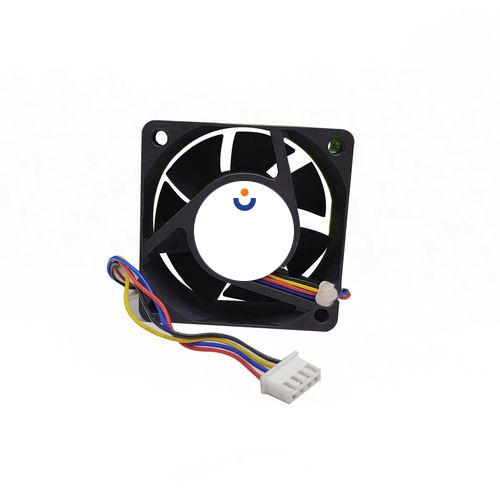
In industrial manufacturing procurement, the purchase of cooling fans usually involves the issue of customized fan functions. For example, when purchasing general consumer electronics cooling fans, factories usually default to not having PWM speed regulation; When purchasing high-value consumer electronics such as computers and most industrial equipment such as frequency converters, it is recommended to choose cooling fans with PWM speed regulation function for servers.
How to choose?
Firstly, you need to understand what PWM is and how it works:
PWM=Pulse Width Modulation.
PWM speed regulation is the use of a "fast switch" to control the average fan speed. The PWM frequency is generally 25kHz, which means it switches 25000 times per second
PWM speed regulation=using high-frequency switches to control the proportion of fan power on time, the larger the duty cycle, the faster the rotation. A 4-pin fan can achieve precise, quiet, and reliable speed regulation with just one signal line.
Secondly, why is it recommended to add a PWM speed controller to the cooling fans of computers/servers/frequency converters/industrial equipment?
Computers, servers, frequency converters, and many other industrial equipment work with larger workloads, higher loads, higher power, and higher equipment temperatures. The most intuitive example is that when your computer is running only one browser program, the computer load is very low, and the CPU/graphics card does not need to run at full capacity, the computer temperature is relatively low. However, when we are playing games or using image processing software such as PS, the display/CPU/storage load is relatively high, and the computer will overheat and sometimes even crash due to high temperatures. As an engineer, when designing solutions, we will consider that when the load is low and the temperature is low, the fan can slow down and the air volume can be reduced; When the load is high and the temperature is high, the fan rotates faster and the air volume is larger.
And PWM speed regulation happens to be the best way to achieve this design. By outputting square wave signals through the motherboard/speed controller/microcontroller, combined with temperature sensors, the motherboard/controller calculates the required speed and outputs PWM signals corresponding to the duty cycle. The internal chip of the fan drives the motor to adjust according to the duty cycle. Low temperature → low duty cycle (slow rotation), high temperature → high duty cycle (fast rotation).
Thirdly, why is it not possible to keep spinning at high/low speed without PWM?
From a usage perspective, maintaining high/low speed is acceptable, as long as the fan can solve the device's heat dissipation problem. But in actual use, you will find many problems. The faster and longer the fan bearings rotate, the faster they wear out; High speed operation of the fan can also generate heat, and high temperatures can cause the lubricating grease to dry up, resulting in increased noise and even system crashes; And if the equipment keeps running at low speed, once the load increases, the fan cannot solve the heat dissipation problem.
Therefore, through PWM speed regulation, the fan motor mostly operates at low speed, resulting in less bearing wear and longer lifespan; High speed when the load is high → rapid heat dissipation and cooling → equipment protection. Multiple benefits in one fell swoop.
Have you learned how to choose? If you have any questions, please feel free to contact us for a cooling solution.