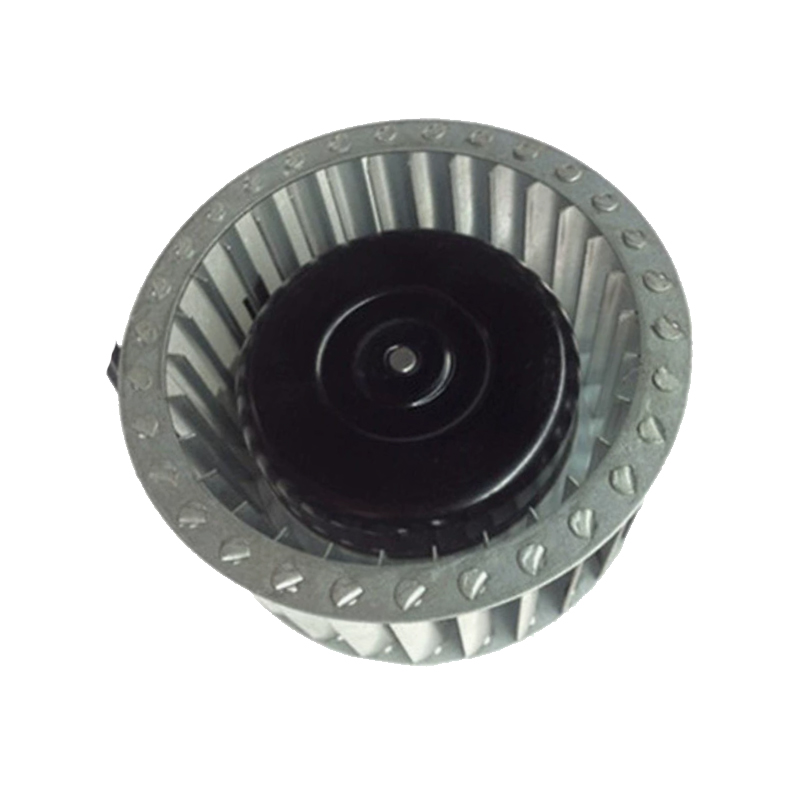
Have you ever noticed why many high-end computers, sophisticated medical equipment, and even your new air conditioner are operating more quietly, using less energy, and having better heat dissipation than before?The biggest contributor behind this is the new cooling star - the EC fan.
LD Industry Fan Customization Engineer, today we will systematically introduce to you: what is EC fan, what are the types of EC fans, the application scope of EC fans, and the advantages of EC fans
1、 What is an EC fan?
The full name of EC fan is "Electronic Commutated Fan", which means "Electronic Reversing Fan" in Chinese. This name sounds very technical, but it's not complicated to understand.
To understand EC fans, one must first have a basic understanding of their two predecessors - traditional AC fans and traditional DC fans.
AC fan: Directly use AC power (220V) from home. It has a simple structure and low cost, but its disadvantages are low efficiency and difficult speed regulation. It's like an athlete who can only run at full speed, either running or stopping, with rough control.
DC fan: uses direct current (such as 12V or 24V). It has high efficiency, low noise, and is easy to adjust speed. Most of our computer case fans are DC fans. But it requires an additional power adapter to convert AC power to DC power, and is not as stable as AC fans in high-power applications.
So, what is an EC fan? You can understand it as the body of an AC fan being fitted with the brain of a DC fan.
A typical EC fan integrates a core component: the EC motor. This motor is essentially a high-efficiency permanent magnet synchronous motor (similar to a DC brushless motor), but it also has a built-in intelligent control circuit board. This circuit board can directly convert the input AC power into DC power, and then use electronic circuits to precisely control the motor's commutation and speed.
Working principle of EC fan: integrated intelligent brain
The core of EC fan lies in its integrated electronic controller. Simply put, its working process can be divided into three steps:
Input and Conversion: After the fan is connected to a regular AC power source, the internal electronic controller will first convert it into stable DC power.
Precise control: The controller constantly monitors the position of the motor rotor and uses control technology to precisely energize the motor coils in sequence, generating a rotating magnetic field.
Drive operation: This rotating magnetic field interacts with the permanent magnets on the rotor to smoothly and efficiently drive the fan to rotate.
Simple summary: EC fan=AC input (easy to install)+DC brushless motor technology (efficient and silent)+intelligent control
2、 What are the types of EC fans?
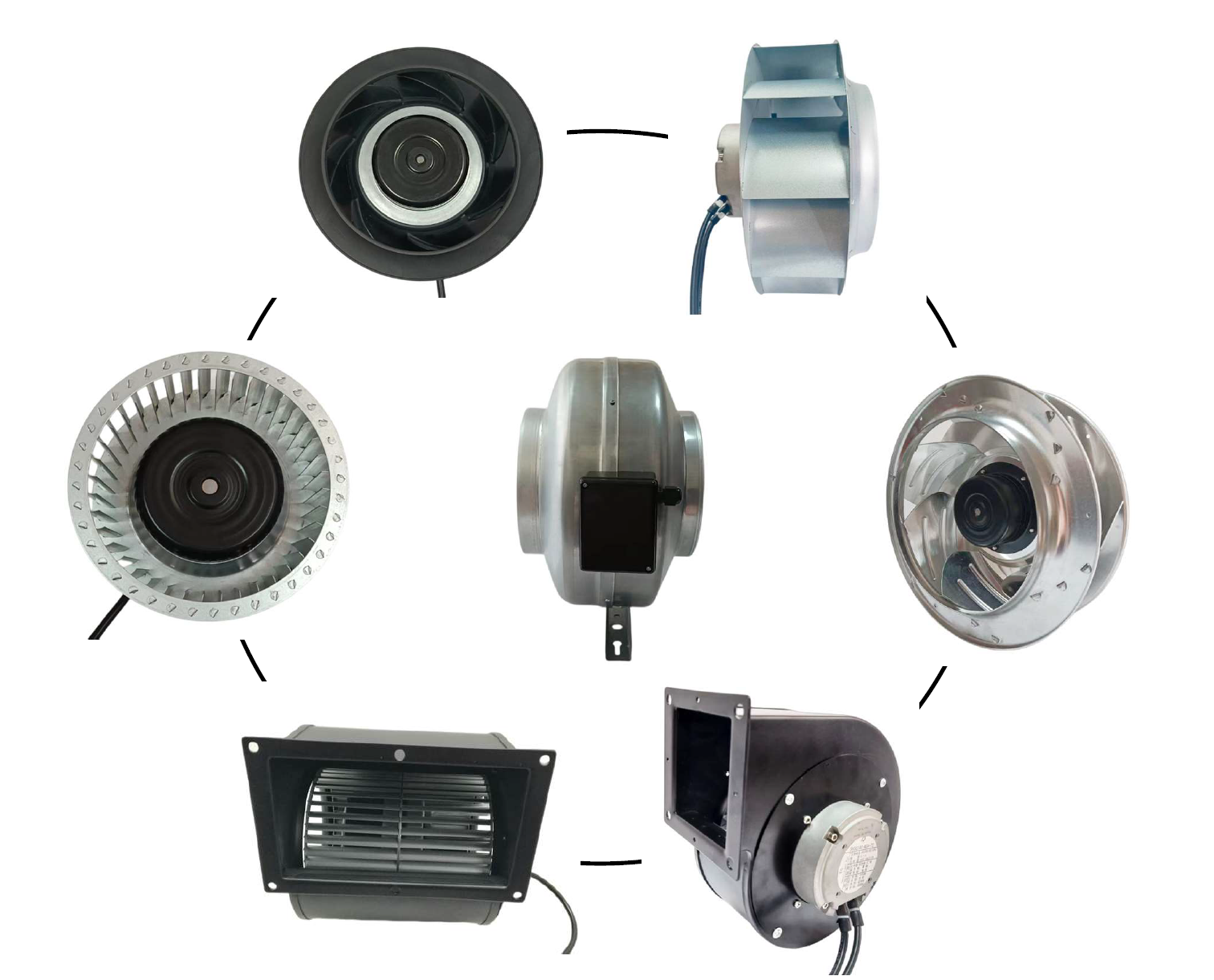
There are many ways to classify EC fans, with the most common being based on airflow direction and structural form:
Axial flow EC fan
Appearance and principle: It is very similar to the common computer case fan we see. When the blades rotate, air flows along the axis of the fan, entering and exiting at the same time, resulting in a large volume of air.
Features: High air volume, low air pressure, compact structure.
Application: Suitable for ventilation and heat dissipation, such as equipment cabinets, outdoor air conditioning units, and large lighting equipment.
Centrifugal EC fan
Appearance and principle: It looks like a snail shell. Air is drawn in from the center (impeller) and then thrown around by the centrifugal force of the high-speed rotation of the impeller, and then discharged from the tangential air outlet. High wind pressure and concentrated airflow.
Features: High wind pressure, relatively small air volume, usually louder than axial flow, but with a longer air supply distance, able to overcome greater resistance.
Application: In situations where centralized air supply or overcoming pipeline resistance is required, such as fresh air systems, purification equipment, range hoods, and blowers.
Backward/Forward Centrifugal EC Fan
This is a further subdivision of centrifugal fans. The bending direction of the backward impeller blades is opposite to the rotation direction, resulting in higher efficiency and lower noise. It is commonly used in high-end ventilation equipment. Forward facing (multi blade) impellers have multiple and short blades, high air pressure but slightly lower efficiency, and are commonly used in household air conditioning indoor units, air purifiers, etc.
Pipeline type EC fan
This is a type of integrated fan that combines a casing and a duct, typically used in ventilation ducts. It integrates axial or centrifugal fans with cylindrical shells and can be directly connected to ducts for boosting or exhausting long-distance pipelines.
3、 What are the advantages of EC fans and why are they widely used
Efficient and energy-saving (most significant advantage): Compared to traditional fans, EC fans have a very prominent energy efficiency advantage, usually saving 30% to 50% more energy than AC fans. In high-end applications, they can even achieve astonishing energy-saving effects of 70% to 91%.
Accurate intelligent control: capable of achieving 0-100% stepless speed regulation, and supporting digital communication protocols such as 0-10V analog signals, PWM (pulse width modulation) or MODBUS, which can accurately match the real-time cooling needs of the equipment.
Long lifespan and high reliability: Due to the use of brushless motors and advanced control technology, mechanical wear and heat generation are significantly reduced, resulting in an average time between failures (MTBF) of typically over 60000 hours.
Quiet and comfortable experience: Thanks to the smooth motor control technology, the current noise and vibration of traditional fans are eliminated, and the operating noise is extremely low, with some products having noise levels as low as 18 decibels.
Global universal wide voltage: Supports AC 90V to 265V global universal voltage, the same model can be used in different countries/regions' power grids, simplifying inventory management.
4、 What are the application areas of EC fans?
The high efficiency and intelligent characteristics of EC fans make them widely used in industrial, commercial, and civilian fields that require high efficiency, noise, and reliability, mainly including:
HVAC system: such as indoor and outdoor air conditioning units, air handling units, to achieve precise temperature control and significantly reduce energy consumption.
Data Center and Telecommunications: Precise heat dissipation for server cabinets, base stations, and other equipment is a key technology for reducing PUE values in data centers.
Commercial cold chain: applied to supermarket refrigerators and cold storage, it can significantly save electricity costs and extend the shelf life of food.
Industrial automation: provides efficient heat dissipation for control cabinets of frequency converters, servo drives, and large industrial machinery.
New Energy and Transportation: Used for heat dissipation management of electric vehicle charging stations and energy storage systems.
5、 What parameters and functions should be paid attention to when purchasing EC fans?
Size and air volume: Choose the appropriate size and required air volume and pressure based on the equipment space and heat generation.
Control mode: Confirm the speed regulation mode supported by the device (such as 0-10V, PWM), and select the fan that matches the interface.
Protection level: In special environments such as humid, dusty, or explosive environments, fans with IP protection level (such as IP68) or ATEX explosion-proof certification should be selected.
Total cost of ownership: Although the unit price of EC fans is higher, the electricity and maintenance costs saved during their 5-10 year lifecycle usually far exceed the initial investment, and the investment return period is generally only 14-24 months.
Finally, to summarize:
The EC fan is like the hybrid car in the automotive world – it is compatible with the existing AC power supply network (just like a hybrid car doesn't need a charging station), yet it has the energy efficiency, smoothness, intelligence, and power of a DC system.
Although the initial purchase cost is slightly higher than traditional AC fans, the energy-saving advantage allows for a payback period of a few years or even months, along with its superior performance in terms of quietness, control, and intelligence. EC fans are quickly becoming a standard configuration in HVAC, data centers, industrial refrigeration, medical equipment, and high-end home appliances.