In the field of centrifugal EC fans (as well as traditional centrifugal fans), "forward tilt" and "backward tilt" refer to the angle and shape of the impeller blades. They directly affect the performance, efficiency, and applicable scenarios of the fan.
1、 What do forward tilt and backward tilt refer to? (Definition and intuitive distinction)
Firstly, imagine observing the centrifugal impeller (a disc-shaped object with blades rotating around the center) from the side of the fan. The bending direction of the blade determines whether it tilts forward or backward.
Forward curved blades (also known as forward impellers):
Shape: The direction of blade bending is the same as the direction of impeller rotation. That is to say, the tip of the blade points forward in the direction of rotation.
Intuitive impression: Like a outstretched palm, pushing air in the direction of rotation. The number of blades is large and short, usually in a dense arc shape, similar to the fence of a pigeon cage or the compressor wheel of a turbocharger.
Backward curved blades (also known as backward impellers):
Shape: The direction of blade bending is opposite to the direction of impeller rotation. The tip of the blade points towards the rear in the direction of rotation.
Intuitive impression: like the blades of a turbine engine, or a blade that is "thrown" backwards. The number of blades is small, long, and the shape is smooth, often with an organic wing shape or a straight back cut.
Quick differentiation mnemonic: Stand on the side of the fan and observe the bending direction of the blades - following the direction of rotation is forward leaning, while turning against it is backward leaning.
2、 How to distinguish? (Appearance and Identification)
If you receive a physical object, you can quickly judge it by the following points:
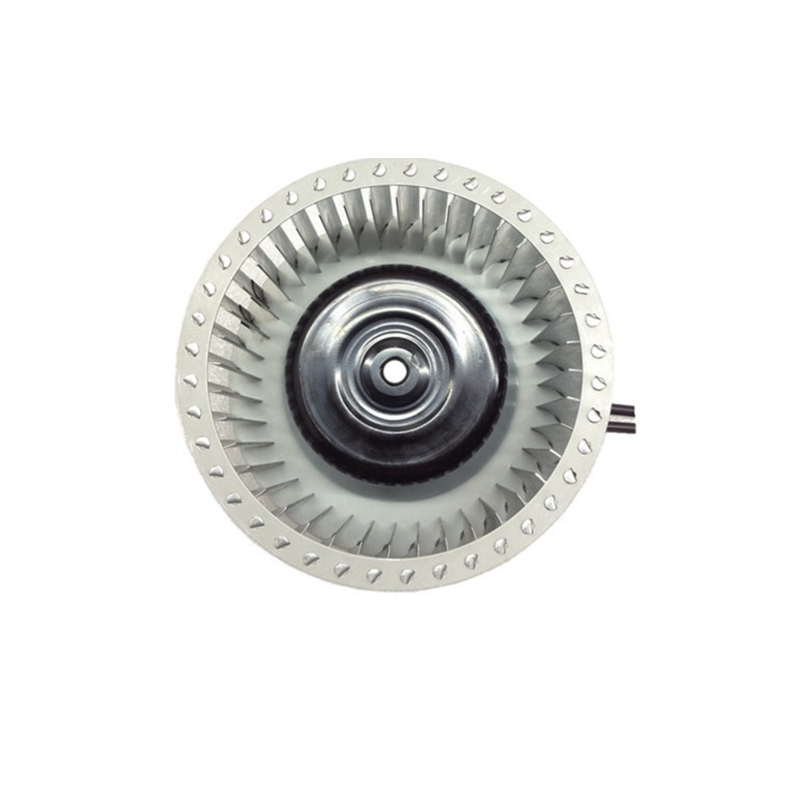
| Features | Forward tilting impeller | Backward tilting impeller |
|---|---|---|
| number of leaves | usually 40 or more | usually 6-16 |
| Blade shape | short and curved, crescent shaped | densely long and straight or wing shaped, sparse |
| Depth of impeller | shallow (thin) axial depth | deep (thick) axial depth |
| Common materials | galvanized steel sheet, aluminum alloy (stamped) | aluminum alloy, plastic, composite materials (cast or injection molded) |
| power-off rotation | with low inertia, fast stopping and high inertia | smooth and continuous rotation |
3、 What are the differences in functionality?
This is the core difference, which directly determines which one you choose.
| Features | Forward tilting impeller | Backward tilting impeller |
|---|---|---|
| Efficiency | relatively low (usually 40%~60%) | very high (usually 65%~85%, high-quality up to 90%) |
| Wind pressure | relatively high (with good static pressure capacity at the same speed) | medium to high (but with a stable curve) |
| The air volume pressure curve is steep | When the air volume changes, there is a large pressure fluctuation and a flat "pressure peak". | When the air volume changes, the pressure remains stable without any peak value |
| Power characteristics | overload prone to burning machine. When the resistance decreases, the power actually increases, which may result in overload protection. | When the resistance decreases, the power also decreases, ensuring safety |
| Noise | large and mostly mid to high frequency sharp noise | small and mostly low-frequency turbulent sound (quieter) |
| Speed range | relatively low | relatively high |
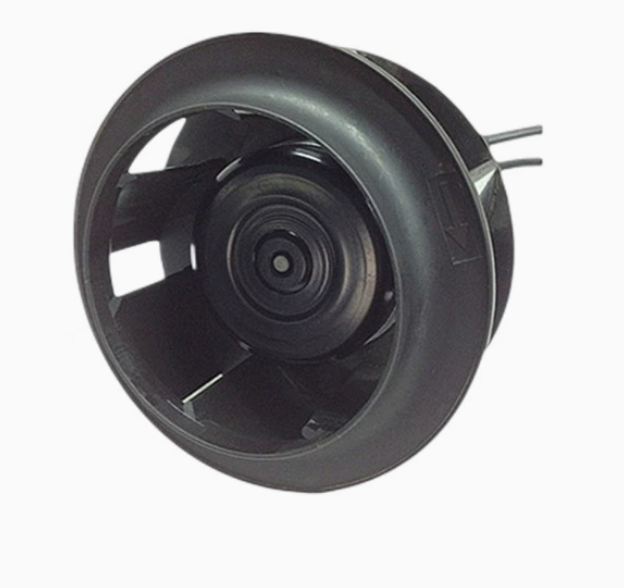
4、 What is the difference in usage? (Typical application scenarios)
Due to the differences in the above characteristics, they each occupy different markets.
Application scenarios of forward leaning impellers
Features: Low cost, compact size, capable of generating high static pressure, but low efficiency, loud noise, and overload risk.
Typical use:
Household air conditioning indoor unit (hanging/cabinet unit): It is necessary to overcome the resistance of the evaporator and filter screen. At the same time, it is required to have a thin and small volume.
Air purifiers and vacuum cleaners require high static pressure to extract dirty air.
Portable air heaters and hand dryers: require high pressure, small size, and low efficiency.
Low end smoke exhaust hood: cost sensitive scenario.
Application scenarios of backward tilting (backward) impellers
Features: High efficiency, low noise, smooth power, safety, long lifespan, but slightly larger in size and higher in cost.
Typical use:
The mainstream choice for EC fans: Almost all high-end EC centrifugal fans use backward tilting blades to fully leverage the high efficiency and adjustable speed advantages of EC motors.
Precision air conditioning in data centers: operates 24/7, prioritizing efficiency and reliability.
Ventilation in hospital operating rooms and clean rooms: requires constant airflow, low noise, and overload free.
HVAC outdoor host: large heat pump, fresh air unit for air supply.
Industrial smoke exhaust and dust removal system: requires long-term operation and stable air volume.
High end household fresh air system: balancing energy efficiency and quietness.
In summary:
Forward leaning: Similar to a "brute force bulldozer" - powerful but prone to fatigue (burning the motor), suitable for short-term, small-sized, low-cost household appliances.
Backward tilt: Like a marathon runner - effortless and quiet, suitable for industrial and high-end commercial equipment that is long-lasting, efficient, and highly reliable.
The LD Industry EC forward leaning centrifugal fan is equipped with intelligent control circuits (PWM speed regulation, locked rotor protection, current limiting protection, soft start) that fundamentally avoid the risk of "motor burning" that I mentioned earlier.
Simply put, traditional forward leaning fans are prone to burning out the motor because they use a "stupid" AC motor; And LD's EC fan uses a "smart" EC motor+protection circuit, you can also use it with confidence according to your needs