Why can a simple cooling fan also be called a precision component? Today, let's take apart a cooling fan and see what components it has?
The phrase 'a sparrow may be small, but it has all five organs' is perfectly used to describe the small stature and high energy of a cooling fan. As a cooling fan design engineer, the design process not only requires knowledge of hardware, material design, fasteners, dust sealing, but also involves various knowledge such as chip control, coil control, wire harness connection, electrical adaptation, and so on.
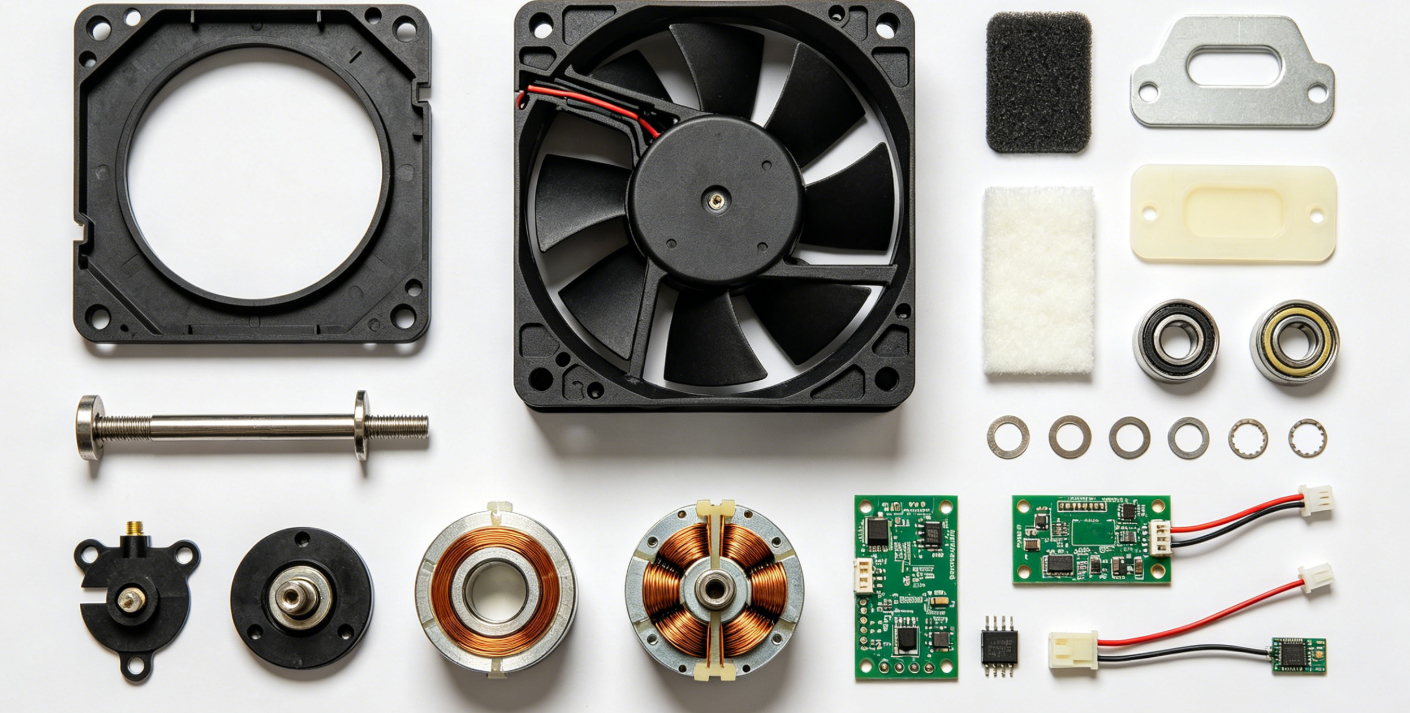
A DC cooling fan includes the following accessories:
1. Outer frame (framework)
The outermost square/circular plastic frame of the fan is usually made of brand new ABS or fiberglass plastic.
Function: Fix the overall structure, install fixed holes, guide and gather air flow, support front and rear protective structures, and have built-in installation buckles and shock-absorbing clips. Poor quality fans often use recycled plastic, which is prone to deformation and cracking at high temperatures.
2. Fan blade
We can see the rotating blades with our naked eyes, which are injection molded as a whole.
Function: Rotate and cut air, generate air volume and pressure, and achieve heat dissipation.
Details: The fan blades are finely balanced to ensure even weight distribution; Low cost fans do not perform dynamic balancing, resulting in shaking, resonance, and loud noise when turned.
3. Anti vibration rubber pad/rubber ring
Many fans come with silicone pads at the corners or shock-absorbing rubber on the outer ring.
Function: Isolate vibration, prevent fan vibration from being transmitted to the chassis shell, reduce overall buzzing low-frequency noise, and belong to accessories that enhance the user experience.
4. Axis (pivot)
There is a thin metal shaft in the middle of the fan blade, usually made of high carbon steel, with high precision.
Function: It supports the high-speed rotation of the fan blades and serves as the center of rotation for the entire fan. Its wear resistance directly affects its service life.
5. Bearings
The core watershed of fan lifespan is installed around the axis.
There are three common types:
Oil containing bearings: the lowest cost, rely on lubricating oil for lubrication, have a short service life, and are prone to abnormal noise and oil leakage after long-term use;
Single ball bearing: With one side bearing and the other side containing oil, it can withstand high temperatures and double its lifespan;
Double ball bearings/hydraulic bearings: high precision, wear-resistant and earthquake resistant, and are not easily damaged even after 24-hour operation. They are commonly used in industry and servers.
6. Oil ring and oil storage cotton
Oil containing fan exclusive accessory, sponge+sealing oil ring.
Function: Store lubricating oil, prevent oil leakage, reduce axial friction loss, and reduce oil storage cotton for low-quality fans. It will dry grind and make noise shortly after use.
7. Stator core
The circular metal laminated iron core in the middle of the fan is made of pressed silicon steel sheets.
Function: Cooperate with the coil to generate a magnetic field, which is the basis of motor power. The quality of the material affects heating and power consumption.
8. Enamel coil
The copper wire coil wound around the iron core is divided into pure copper wire and copper-clad aluminum wire.
Function: After being powered on, it generates electromagnetic induction and drives the fan blades to rotate. Pure copper wire has good conductivity, low heat generation, and aging resistance; Copper clad aluminum has low cost, easy heating, and short lifespan.
9. PCB driver circuit board
A small circular circuit board on the back of the fan is the brain of the fan.
It integrates various small components and is responsible for power supply, voltage regulation, speed control, and signal control.
10. Electronic components
Solder on PCB board, including driver IC, capacitor, resistor, Hall sensing element, voltage regulator diode, etc.
Hall element: induces magnetic field, controls coil commutation, and keeps the fan rotating at a constant speed;
Protective components: High end fans come with overvoltage, overcurrent, reverse connection, and stall protection, and even if the positive and negative poles are connected incorrectly, they will not burn out.
11. Magnetic ring (outer rotor magnetic steel)
A ring-shaped permanent magnet embedded inside the fan blade.
Function: It interacts with the magnetic field of the stator coil, drives the fan blades to rotate when powered, and is the power source of the brushless DC fan.
12. Buckle, snap ring, gasket
Small snap spring and wear-resistant gasket at the end of the axis.
Function: Lock the fan blades to prevent axial movement, control clearance, and reduce shaking and friction noise.
13. Dust sealing cover
Circular sealing cap on the back of the fan.
Function: Dustproof, anti dust and anti water ingress, preventing internal dust from entering and damaging bearings, while locking the internal lubricating oil from evaporating.
14. Power harness/terminal wire
2-wire, 3-wire, and 4-wire ribbon cables led out from the fan.
2-wire: positive and negative pole power supply, constant speed operation;
3 wires: Multiple speed signal wires can be added to detect speed;
4-wire: Supports PWM intelligent speed regulation, automatically adjusts speed according to temperature.
Finally, in summary:
A regular DC brushless cooling fan, disassembled into three main categories of parts:
Structural appearance components: outer frame, fan blades, shock-absorbing rubber pads, sealing cover;
Rotating transmission components: shaft, bearing, oil storage cotton, clamp spring gasket;
Motor circuit components: magnetic ring, stator core, enameled coil, PCB board, Hall element, driver IC, power cord.
And the quality and stability of these parts directly determine the cost of the fan.