A small DC axial flow cooling fan looks the same, with cheap ones costing only 0.1 US dollars and expensive ones selling for over 100 US dollars. The prices of different brands can differ by 100 times, and the same brand with the same specifications can also differ by several times. What is the reason for this?
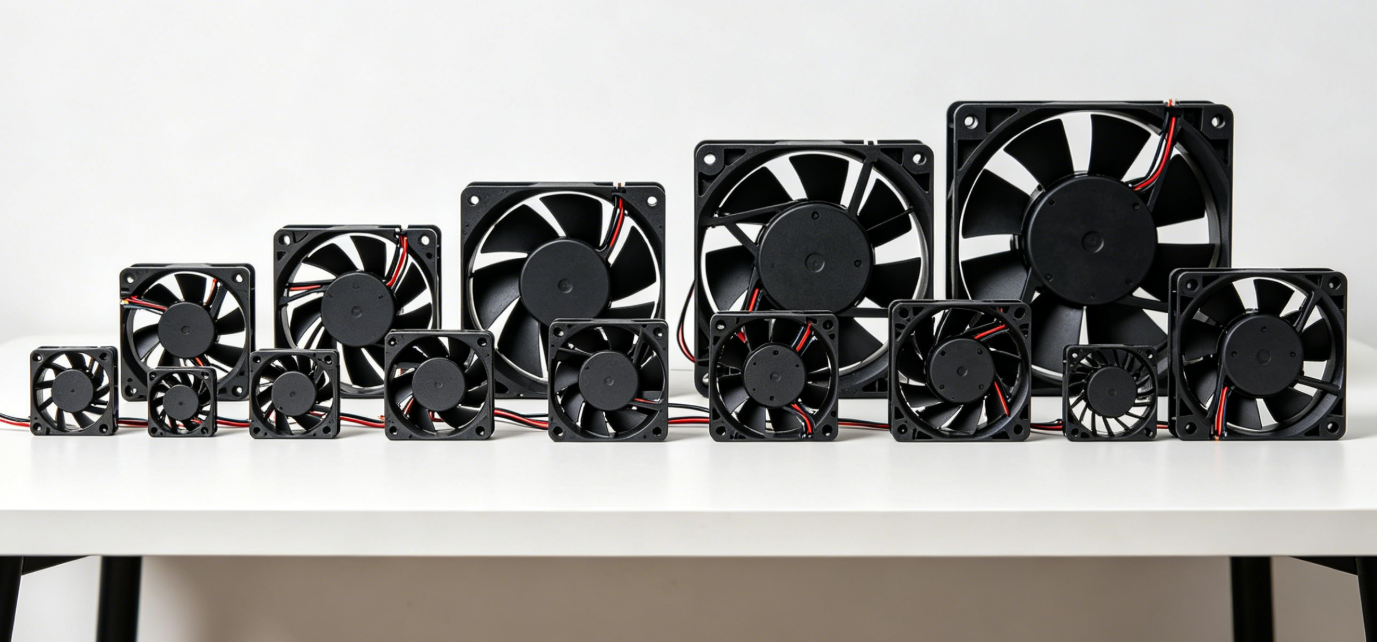
Taking DC cooling fans as an example, DC axial cooling fans are mostly rectangular in shape, with a small number being circular and an extremely small number having irregular frames The sizes are generally 20*20, 30*30, 40*40... 120*120, 170*170. This is true for all brand sizes.
Setting aside brand premium factors, it is easy to judge the external price of a cooling fan with the naked eye by observing the materials of the frame and fan blades, such as ABS, PBT, stainless steel, aluminum alloy, and other alloy materials. However, in reality, the materials of the outer frame and fan blades have very little impact on the price of the fan, because the pricing is very transparent.
What really makes the prices of cooling fans so vastly different lies inside, in places that are invisible to our naked eye.
1.Bearings: The Technological Gap from Oil-Lubricated to Magnetic Levitation
Bearings are the "joints" of the fan, determining its lifespan, noise level, and reliability.
Oil-impregnated bearings have the lowest cost but a short lifespan; double ball bearings have the longest lifespan and are more resistant to high temperatures, but are noisy; hydraulic bearings strike a good balance between silence and cost; magnetic levitation bearings almost eliminate friction, offering both an ultra-long lifespan and top-notch silence, but are expensive.
| Bearing Type | Service life | Craftsmanship difficulty | Cost | Noise |
|---|---|---|---|---|
| Sleeve | 5,000 - 15,000 h | ★ | ★ | ★ |
| Hydraulic / FDB Bearings | 40,000 - 50,000+ h | ★★ | ★★ | ★ |
| 1 Ball | 30,000 - 40,000 h | ★★ | ★ | ★★ |
| Double Ball | 50,000 - 100,000+ h | ★★ | ★★★ | ★★★ |
| Magnetic levitation bearing | 50,000+ h | ★★★ | ★★ | ★ |
2.Coil and Copper Wire Materials
Copper-clad aluminum and pure copper are indistinguishable to the naked eye.
Ordinary users cannot tell the difference in motor coils, but there is a huge difference in cost and durability:
Cheap Fan: Copper-clad Aluminum Wire
The exterior is copper-plated, with aluminum wire inside, resulting in poor conductivity, high heat generation, and poor high-temperature resistance. It's prone to burning out the coil when fully loaded for extended periods, and the cost is extremely low.
Mid-to-high-end fan: All pure copper wire
High conductivity efficiency, low heat generation, resistant to high and low temperatures, less prone to burning out, more stable in long-term full-load operation; the cost of copper wire materials is much higher than that of copper-clad aluminum.
In addition, the number of coil windings and the purity of the silicon steel core also affect power consumption, heat generation, and stability. Low-end fans that cut corners will only use inferior cores, saving costs but resulting in greater losses.
3. Motor and control chip – the "brain" and "heart" of the fan
Motors are classified into different levels, and high-end motors (such as brushless DC motors, BLDC) have significantly higher efficiency and quieter performance compared to ordinary motors. At the same time, the chip is the core component that controls the fan speed, and there is a significant difference in sensing accuracy between different grades of chips; low-end chips may cause the fan to fail in certain areas. More advanced drive technologies (such as FOC) can ensure that the fan remains stable and quiet at different speeds.
The design principle of LD Industrial's cooling fans is that we only design fans that meet your needs. The engineers at LD Industrial will consider the user's application scenario, equipment usage, cost control, and feature selection to customize a satisfactory cooling fan for you.