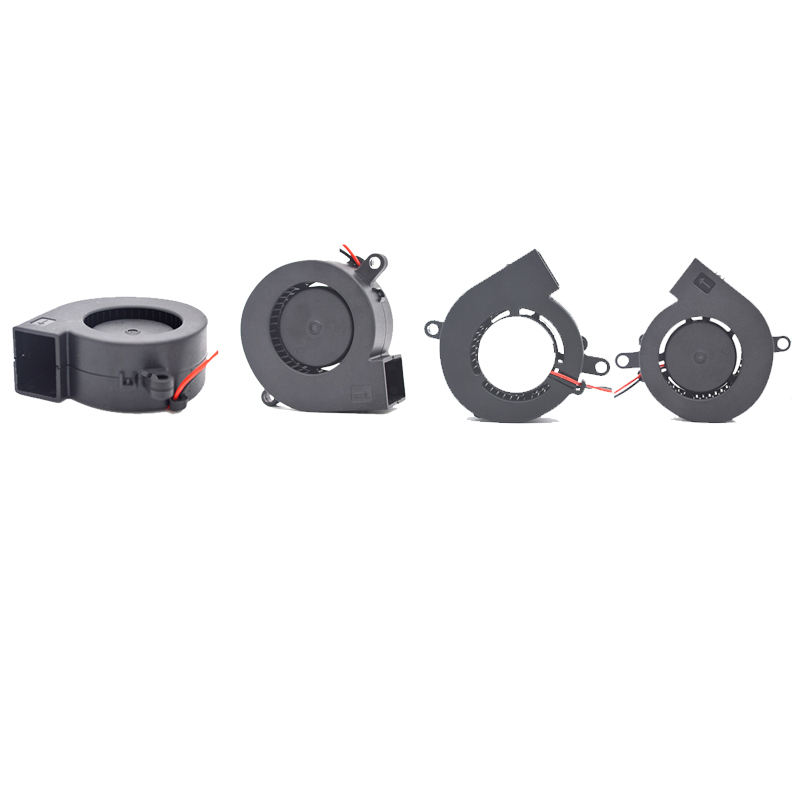
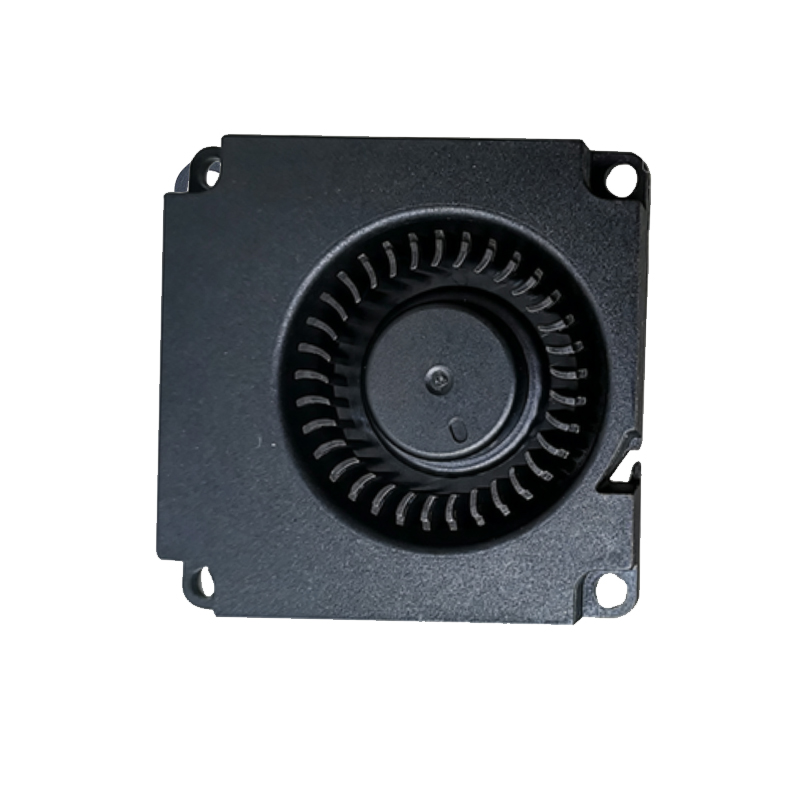
Blowers are essential cooling components for many industrial electrical accessories, home appliances, and 3C products If you have ever disassembled a humidifier, computer, server, car seat cushion, 3D printer, or beauty device, you must have seen blowers of various sizes and shapes. Even though they are all plug-in blowers with DC power supply and built-in impeller motors, some have wide and flat air outlets, some have narrow and concentrated outlets, and others are designed to fit into irregular narrow ducts, with very noticeable differences in size.
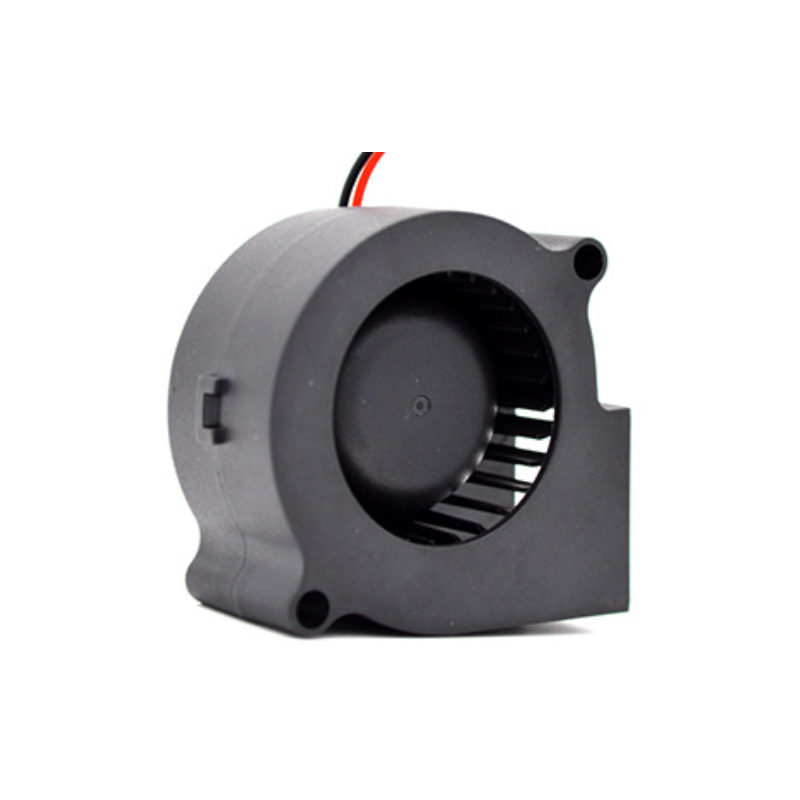
So, have you ever wondered why manufacturers don't standardize the size of the air outlets for DC blowers, which are used for air circulation and cooling, and instead produce multiple specifications? Is this really unnecessary?
What the LD industrial fan design engineers must tell you is that the size of the blower, as well as the size of the air outlet, are never randomly designed. Every adjustment to the 1.0inch diameter is a professional design that precisely matches aerodynamic requirements, equipment conditions, energy consumption reduction, noise reduction, and installation space compatibility. The size of the air outlet directly determines whether the blower is easy to use, whether the equipment is stable, how much power it consumes, and how noisy it is.
With the blower power essentially fixed, the smaller the outlet, the faster the airflow, but the coverage area (air volume) will be correspondingly reduced; the larger the outlet, the wider the airflow coverage, but the "force" of the airflow will be much softer.
This is one of the most basic principles in fluid mechanics: the implication of Bernoulli's principle, or the intuitive manifestation of the continuity equation of flow. When air is generated by the high-speed rotation of the blower fan and is forced through a narrow outlet, it is like squeezing a hose with your fingers; the pressure can be converted into kinetic energy, causing a dramatic increase in speed. On the other hand, a large-diameter air outlet allows air to flow out "calmly," at a relatively low speed, but can push a large amount of air at once.
1:DC Blower, naturally operates based on "air pressure + air volume"
Ordinary DC fans blow air directly in and out, while DC blowers draw air from the side, use a vortex shell for pressurization, and direct the airflow out. The core operation relies on two key indicators, and all subsequent outlet designs are based on these two points:
First, air volume: simply put, it refers to the total amount of air that the blower can push out in a unit of time, focusing on "wide coverage and full-area air delivery."
The second is static pressure: it is the force that "pushes and forces" air through, relying solely on the pressure to overcome resistance when dealing with clogged filters, bent ducts, narrow cavities, or the enclosed interiors of equipment.
The size of the air outlet is essentially a "physical adjustment switch" used by manufacturers to control airflow and balance air pressure. Without changing the motor speed or replacing the impeller, adjusting the diameter can adapt to different usage scenarios.
Large air outlet: featuring wide width and large air volume, uniform air supply, and full coverage throughout the entire area
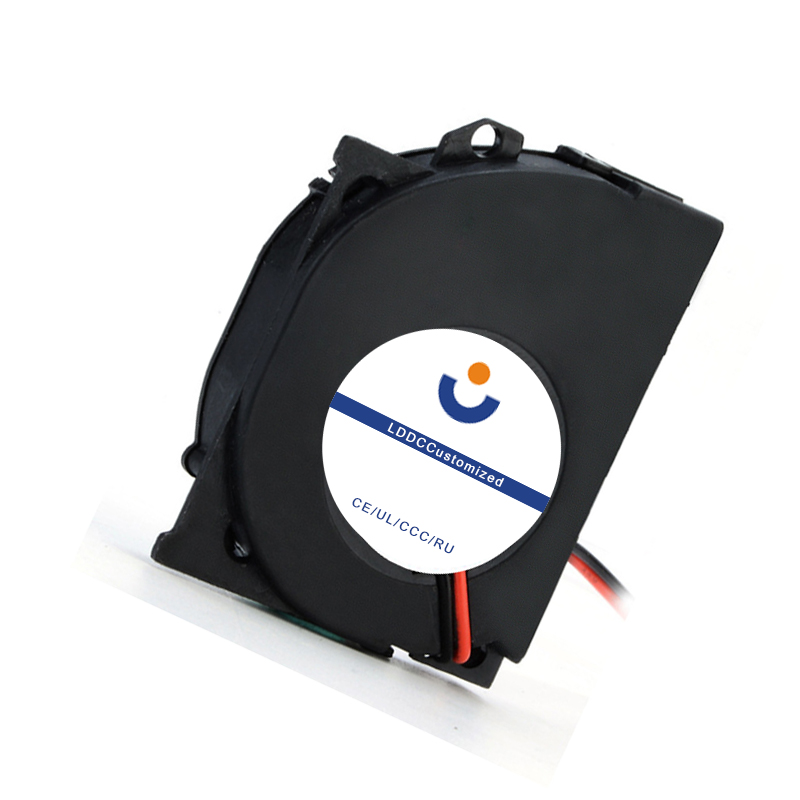
The core advantage of a large-diameter air outlet is its spacious passage and almost no additional resistance to air flow. When the blower impeller rotates at full speed, a large amount of air can be smoothly and quickly discharged without being squeezed or congested, naturally outputting sufficient air volume.
This type of large air outlet blower is specifically designed for low resistance, wide air blowing scenarios: small space ventilation, open equipment heat dissipation, large-area flat air cooling, household desktop humidification and air supply, etc. The advantages are very intuitive: soft and non irritating wind sensation, uniform temperature throughout the area, low motor load during long-term operation, less likely to heat up and age, and longer overall service life.
But it also has obvious shortcomings: the wind disperses quickly and the pressure is weak. Once encountering situations such as filter blockage, air duct bending, long pipelines, and dense internal components blocking the equipment, the high air volume cannot penetrate at all, and the air supply efficiency drops sharply, making it difficult to exert force.
Small air outlet: featuring strong pressure and strong wind bundles, drilling narrow gaps, resistance resistance, and fixed-point air supply
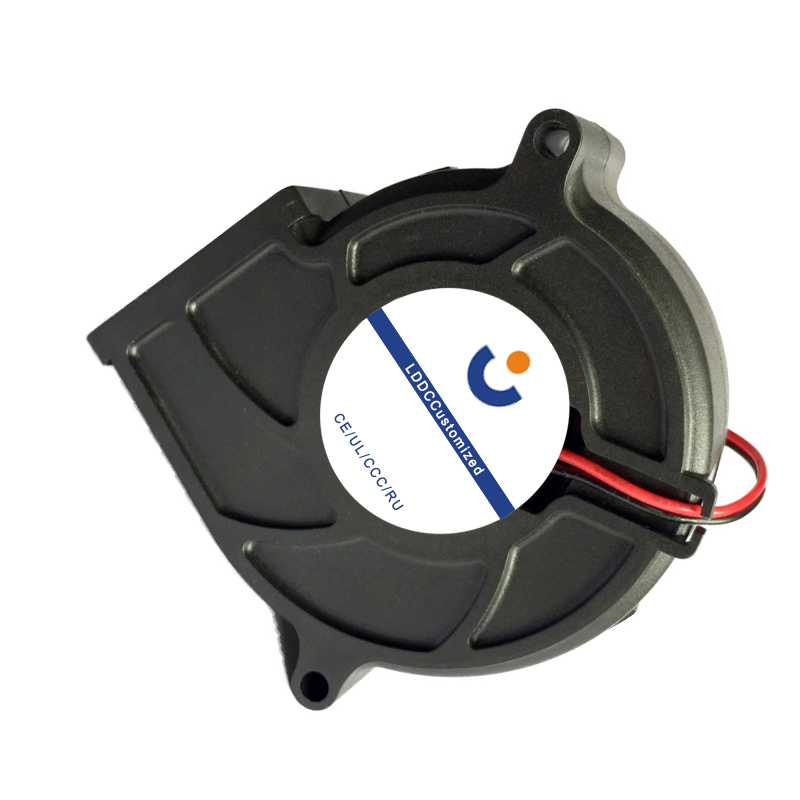
The small air outlet is equivalent to adding a "tightening nozzle" to the airflow. According to the principles of basic fluid mechanics, under the same gas volume, the narrower the passage, the faster the flow rate, and the higher the pressure. The originally loose and scattered airflow was forcibly gathered and compressed, and instantly turned into a highly penetrating gust of wind, causing the wind pressure to soar significantly.
So the small air outlet DC blower is specifically designed to serve high resistance, fixed-point, and penetrating conditions: passing through dense heat sinks, penetrating thick dust-proof filters, fitting slender curved air ducts, accurately blowing narrow cavities, and local fixed-point strong cooling. Even if the pipeline is bent, the space is narrow, and there are many obstacles, the air can be steadily delivered to the designated location without any dead corners.
The corresponding disadvantages are also very real: the airflow compression friction increases, and the wind noise will slightly increase; The motor needs to do more work to overcome air flow resistance, resulting in a slight increase in power consumption; Narrow blowing range, only suitable for precise fixed-point operations, not suitable for large-area global air supply
2: It is necessary to match the installation space and air duct structure of the whole machine. If the size is wrong, it cannot be installed or used
Regardless of performance, discussing size is just empty talk. The hardware installation conditions of the device are the hard threshold that determines the size of the air outlet. The internal structures of different electrical appliances and small industrial equipment vary greatly, and the installation position, air duct interface, and opening size left for the blower are fixed and fixed, with no room for adjustment.
Compact and portable devices, with every inch of space inside, can only accommodate small volume blowers, and the matching air outlet must be made small and narrow to fit the layout of narrow air ducts; Large ventilation equipment, open cooling unit, sufficient reserved space inside, wide air duct diameter, naturally matched with large air outlet blower, suitable for overall air supply structure.
If the size of the air outlet does not match, either the forced installation will result in severe air leakage and greatly reduced air supply efficiency, or the air duct cannot be directly connected, and the entire assembly will be scrapped. In industrial mass production, the size of the air outlet should first align with the equipment structure interface, and then optimize the air supply performance.
3: noise control, power consumption control, motor protection. Improper size can easily damage the equipment
Many people overlook one thing: if the size of the air outlet is not reasonable, it will directly drag down the blower motor. If the air outlet is too small and the resistance is too high, the motor will operate under high load and pressure for a long time, which not only increases power consumption, but also quickly heats up and heats up. The bearings and coils will accelerate aging, and soon after use, they will experience lagging, abnormal noise, and shutdown faults.
On the contrary, if the resistance matching is reasonable and the air outlet size is adapted to the working conditions, the blower can operate smoothly and at low load, with lower noise, less vibration, controllable temperature rise, and continuous operation around the clock without easy problems. Simply put, matching the working conditions of the air outlet is to reduce the load and prolong the life of the motor; Improper allocation of air vents is equivalent to exceeding the lifespan of the blower in advance.
4: Standardized subdivision selection, convenient for precise matching according to needs, without wasting performance costs
When manufacturers mass produce, they make the outlet of the DC blower into multiple standard sizes in order to refine the selection according to demand. If you need high air volume, choose the wide mouth version; if you need strong air pressure, choose the narrow mouth version; if you need to adapt to irregular equipment, choose the customized small mouth version. There is no need to spend extra money on performance that is not needed, and there will be no situation where performance is insufficient. Unifying non-standard sizes can actually result in resource waste and reduced adaptability.
Quick summary of one article: The size of the air outlet is selected based on "air volume" and "air pressure"
Large air outlet: low resistance, high air volume, soft wind sensation, full coverage, suitable for open heat dissipation, large-area ventilation, energy-saving, durable, and low noise;
Small air outlet: high air pressure, strong penetration, fixed-point air supply, strong resistance, suitable for narrow air ducts, with filters, and internal blowing of dense components;
Core essence: The size of the air outlet is a key design that balances air volume, air pressure, noise, power consumption, and installation space, and is not arbitrarily processed.